Export orders need more than a sales invoice
A domestic sale is a lorry and an invoice. An export order is a contract that runs for weeks: the Incoterm decides who pays freight and insurance, the port of loading and port of discharge decide the route, the number of containers decides how much stock must be ready on stuffing day, and a set of documents has to be complete before the shipment can leave. Running that from email and a spreadsheet works for one shipment a season. It does not work for several at once.
In Grano, an export order is an order of kind export with its own fields – Incoterm, ports, containers, documents and a status – and its own register under Sales → Exports. The order page shows the same order → dispatch → invoice → payment strip as any other order, so the export desk and the accounts team look at one record.
Reserve the rice before someone sells it
The most common export problem in a mill is not paperwork – it is stock. Rice set aside for a container is dispatched to a local buyer on a busy day, and the shortfall is found at stuffing. Grano lets you allocate specific lots to an order. Once reserved, that stock cannot be used in any other sale; only the order's own dispatch can draw from it. The godown keeper sees the reservation, and so does the sales team.
Traceability from bag to farmer
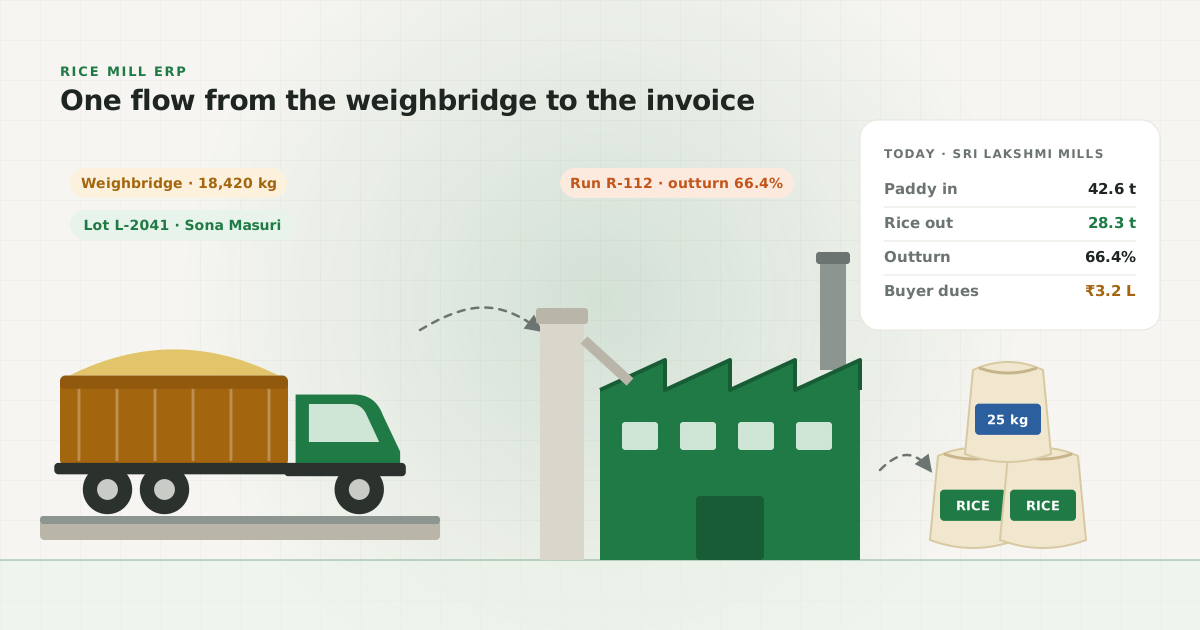
Importers and inspection agencies increasingly ask where a consignment came from. Because every purchase in Grano creates a paddy lot, every milling run links paddy lots to rice lots, and packing links rice lots to bags, the lot page can tell the whole batch story:
- The bags packed, with sizes and any damaged or rejected bags.
- The rice lot and the milling run that produced it, with outturn.
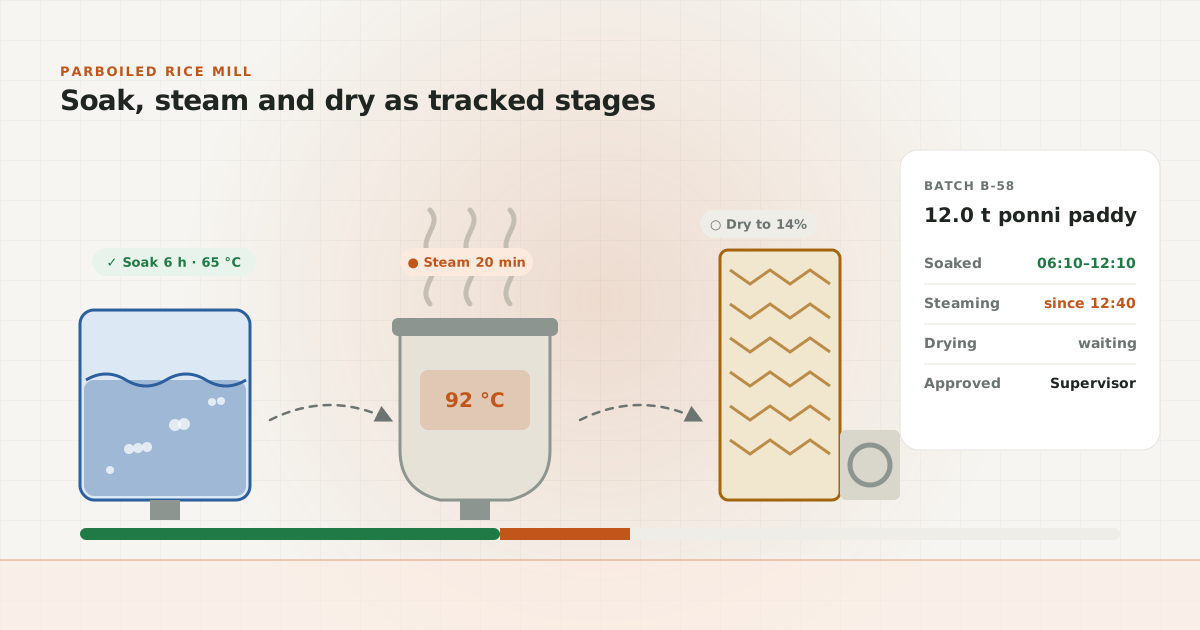
- The process stages the batch went through and who approved each one.
- The paddy lots that went in, the suppliers who sold them and the dates they arrived.
That answer is ready on one screen instead of being rebuilt from weighbridge slips.
Schemes and export resources
Exporters deal with registrations and government schemes that have renewal dates and portals of their own. Grano includes a schemes and registrations tracker with a starter list; every entry links only to the official source, so your team works from the real rules rather than a summary.
Enquiries from overseas buyers can be logged too, with a same-day first contact, a contact log and a lost reason when a deal does not happen. When an enquiry turns into business, it becomes an order, so the history of the buyer stays in one place.
Export orders and the schemes tracker come with the Enterprise plan, from ₹19,999/month, or as the Export desk add-on on a smaller plan. The rest of the mill – purchase, milling, packing and stock – runs in the same app, in English, Tamil or Hindi.
How much paddy do you need for an export order?
Work backwards from the container. Say the contract is for 5 containers and the buyer wants 1,000 bags of 25 kg in each. That is 5,000 bags, or 125 tonnes of packed rice. Allow for the bags that will be rejected at packing and for any sorting the buyer's grade needs. Then divide by your outturn on that variety. At a 65% outturn, 125 tonnes of rice needs about 192 tonnes of paddy.
Grano helps with each step of that sum. Your own yield report gives the outturn per variety, from real runs rather than a rule of thumb. Godown stock shows how much finished rice is already on hand. Reservations show how much of it is already promised to another order. What is left is what you need to buy or mill before stuffing day.
Packing closes the loop. When the reserved lots are packed, the bag count, the bag size and any damaged or rejected bags are recorded against the lot. On stuffing day the export desk knows how many good bags are in the godown for each container, and if the count is short, it knows that before the lorry leaves for the port, not after.
What documents does a rice export shipment need?
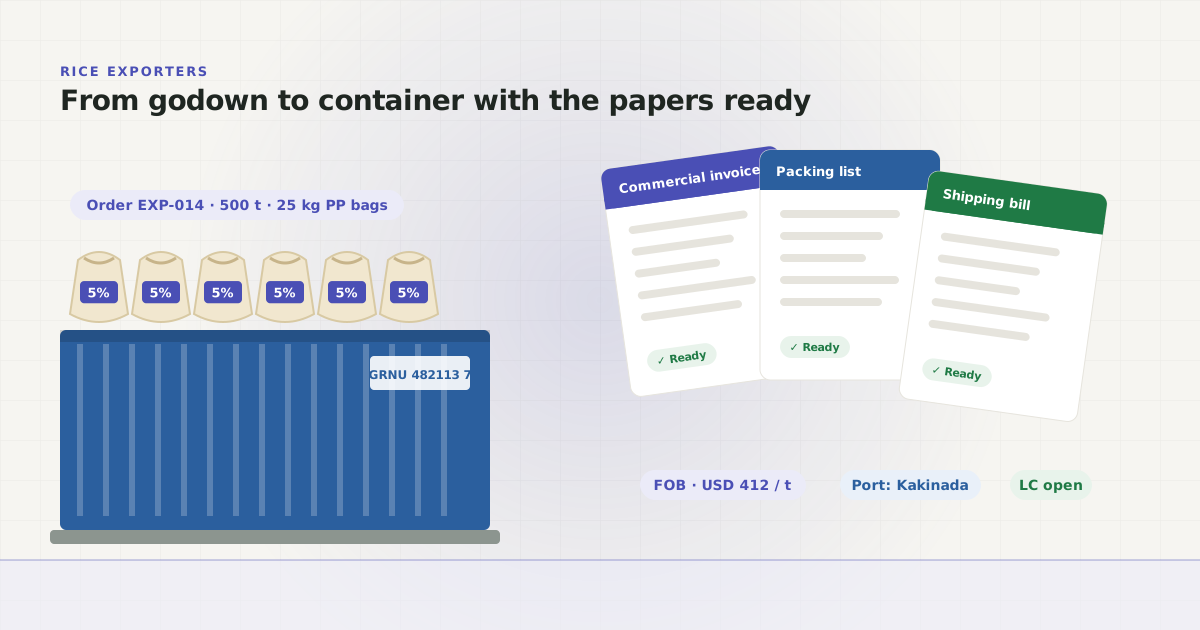
The set depends on the buyer, the destination and the contract, so check it for every order. Shipments commonly involve a commercial invoice, a packing list, a shipping bill, a bill of lading, a certificate of origin and any quality, fumigation or plant health certificates the buyer or the importing country asks for. Your CHA or freight forwarder will usually prepare some of these.
Grano does not prepare these documents. It keeps the list for each export order and the status of each one – ready, pending or missing – so the export desk can see at a glance what is holding a shipment, and nobody discovers a missing certificate the day the container is due at the port.
Running an export order: a checklist
- Create the export order with the buyer, product, quantity, Incoterm, ports and containers as soon as the contract is signed.
- Reserve the lots the same day, before the sales team sells them locally.
- Agree the bag size and marking with the buyer, and pack only what is reserved.
- List the documents the buyer needs and mark each one as it is ready.
- Dispatch against the order, so the reservation is used and the stock leaves the right godown.
- Open the lot page and share the batch story when the buyer asks where the rice came from.
The usual mistake is reserving too late. Once a lot is allocated, any other sale that tries to use it is refused, so the safest moment to reserve is the day the order is confirmed, not the week before stuffing.