Your accountant can stay in Tally
Almost every rice mill in India already keeps its books in Tally, and the auditor knows exactly where to look. Asking the accountant to move ledgers into a new system is the fastest way to stall a software project. Most of what goes wrong in a mill is not in the books anyway – it is in the lots, godowns, milling runs and dispatches that happen before the accountant sees a voucher.
Grano's Operations edition is built for that mill. It runs the full operations side – purchase, lots, milling, process stages, packing, stock, orders and dispatch – and leaves money to Tally. It is one switch on the mill, not a separate product, so nothing about the operations screens is cut down.
What changes in the Operations edition
- No prices or ₹ on any screen, for any role – the owner included.
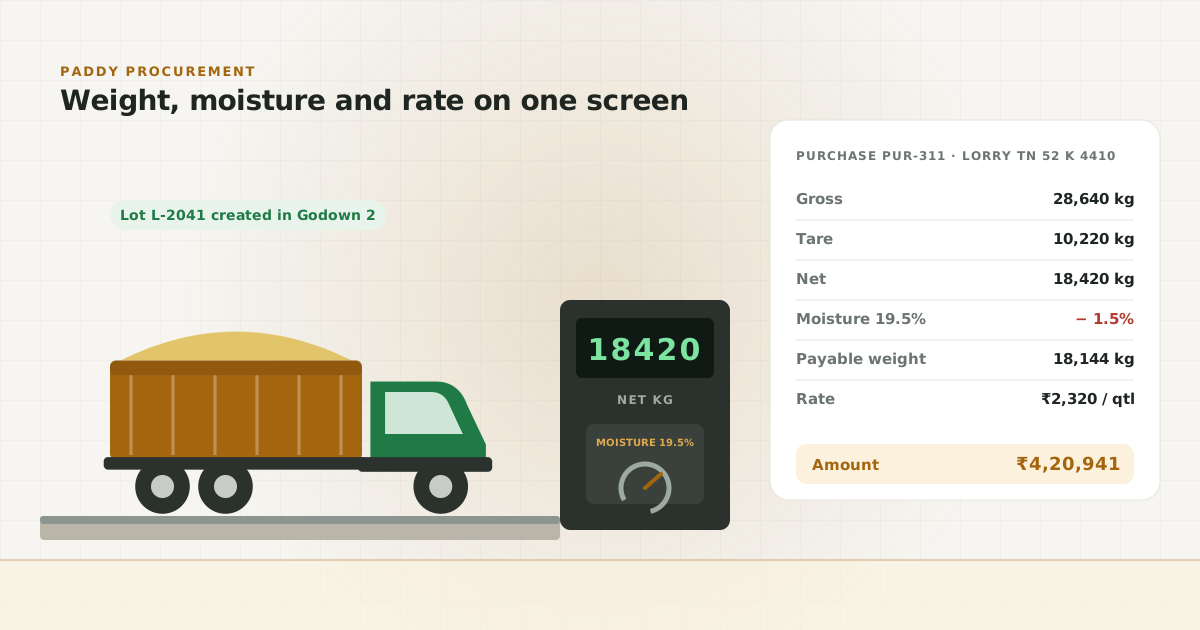
- Purchases record weights, moisture, grade and lot, with no rate.
- Sales and dispatches create delivery challans numbered DC-, not tax invoices, and post no ledger.
- Accounting, GST reports, e-invoice, price lists and payments are hidden.
- Bags and CMR entries are tracked in quantities only.
- The home screen is the Operations dashboard: stock, batches, stages, tasks and dispatches.
Because nothing on screen shows a price, you can give phones to gate operators, godown keepers and shift supervisors without worrying about what they can see. The accountant takes the challans and weighbridge details and enters bills in Tally as today.
When you want the money side too
Some mills start with operations and later want ledgers, GST and receivables in the same place. The finance side is part of every plan, so it is a switch, not an upgrade. With finance on, purchases carry rates (operators can still save with the price pending for the owner to price later), sales become GST invoices, and vouchers and masters can be exported to Tally as CSV / XML so the books in Tally stay complete.
Switching keeps your data. If you move an existing mill to the Operations edition, ledger history is kept, just not shown. If you switch back later, the money side starts from that day – loads and dispatches recorded without prices have nothing to backfill, so plan the switch at the start of a month or season.
Owners often ask how the accountant gets what he needs without prices in the system. The answer is that he already has the prices – in the contracts, the rate agreed with the broker, or the customer price list in Tally. What he was missing were reliable quantities, lots and dates, and those now come from Grano every day instead of from a notebook at month end.
As an illustration of the split: the godown keeper records a dispatch of 200 bags on a DC- challan from his phone in Tamil; the accountant sees the challan the same evening and raises the bill in Tally. Nobody re-counts, and nobody outside the office sees a rate. The Operations edition is available on every plan, from ₹4,999/month.
What does Tally need from a rice mill?
For a rice mill's books, the accountant needs four things every day: purchase bills with the supplier, weight and rate; sales bills with the buyer, quantity, rate and GST; payments and receipts by cash or bank; and expenses. At the year end the auditor also wants closing stock that matches what is actually in the godowns.
In the Operations edition Grano supplies the quantities: net weight after moisture deduction for every load, quantities and lorry details on every DC- challan, and stock per godown and stack on any date. The accountant adds the rates he already has and enters the bills in Tally. Closing stock for the auditor comes from Grano's stock ledger, not from a count done in a hurry on 31 March.
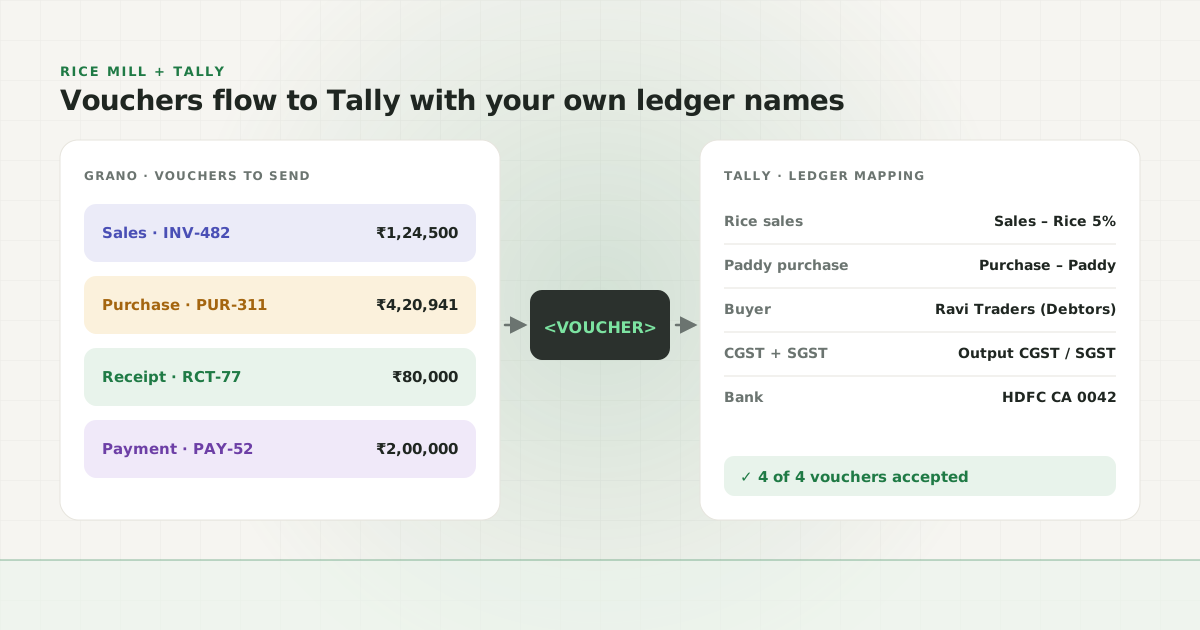
With the finance side on, Grano makes the vouchers itself – purchases, sales with CGST/SGST or IGST, payments, receipts and expenses – and exports them with your masters as CSV / XML. The ledger names are mapped per mill in Settings → Tally, so a sale lands in your existing sales ledger and each party in its own ledger, instead of creating new ones your auditor has to clean up.
Moving from notebooks while Tally stays
The move is about the operations side, so it does not touch the books. Pick a start date – the first of a month works well – and do the setup the week before.
- Import suppliers, buyers and products from Tally XML or CSV, so names match what the accountant already uses.
- List godowns and stacks as they are, and enter the stock counted on the start date as opening stock.
- Give phones to the gate operator, the shed supervisor and the godown keeper, each in their own language.
- For the first week, keep the notebook too and compare the evening totals.
- From the second week, the accountant works from the challans and purchase entries in Grano.
Mills that later turn finance on can bring their Tally opening balances in with the start-from-Tally import, so the books in Grano begin from the same figures as the books in Tally.
Common mistakes when running two systems
- Different party names in Grano and Tally. Import masters from Tally rather than typing them, and the bills match.
- Billing from the notebook instead of the challan. If the accountant bills from Grano's DC- challans, every dispatch is billed once.
- Letting stock drift. Record transfers between godowns and do stock audits per stack, so Grano's stock stays true.
- Switching editions in the middle of a month. Plan it for the start of a month or season, as above.