Custom milled rice is a different business inside the mill
Under custom milling, the paddy is not yours. A government agency or civil supplies corporation allots paddy to the mill, the mill hulls it, and a fixed quantity of rice has to be delivered back within the agreed time. The mill earns a milling charge and keeps the by-products as agreed. For many mills, CMR keeps the machines running between their own purchases – but only if the paddy and rice are tracked separately and the balance is always known.
In Grano, each CMR agreement is a contract with its own register. Paddy received under the contract is entered as a CMR entry: it creates a lot and adds paddy to the godown with a cmr_in movement. Rice delivered is entered the same way and goes out of the godown as a cmr_out movement. Because stock is a ledger of movements with a reason on every row, contract paddy and your own paddy can share a godown without getting mixed up in the records.
The received → milled → delivered strip
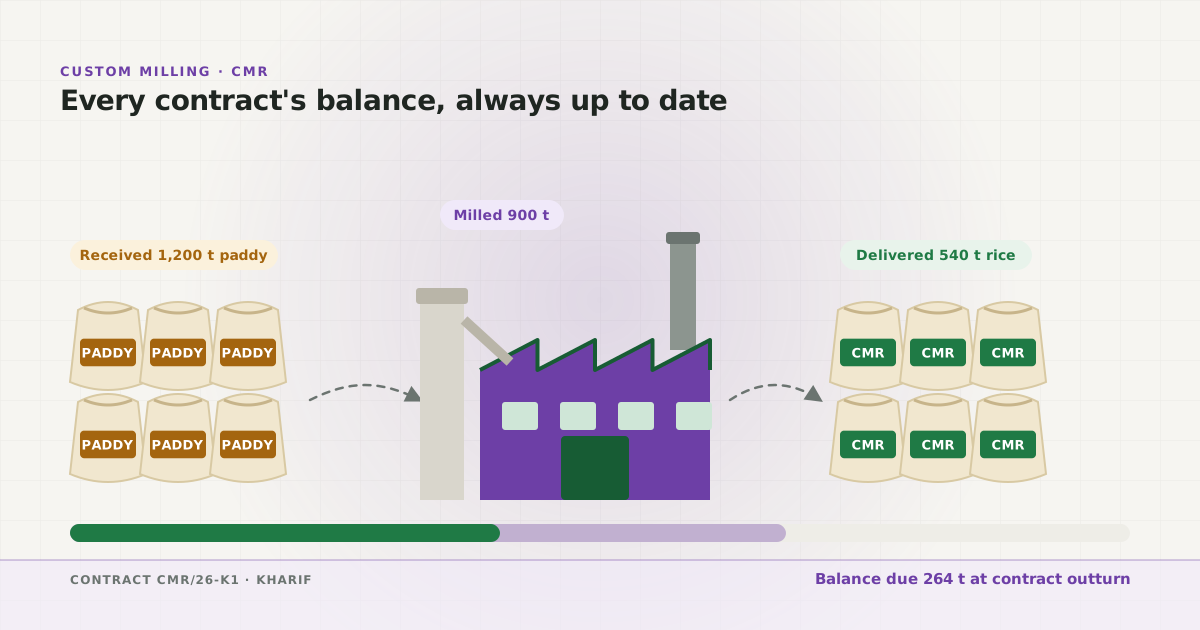
Every contract page opens with a strip of four numbers: paddy received, paddy milled, rice delivered, and the balance of rice still due. Below it, a timeline lists every entry in order. When deliveries are behind, a pending banner says so on the contract page – before an agency reminder arrives.
- Received: the total paddy accepted under this contract, lorry by lorry.
- Milled: paddy from these lots that has gone through milling runs.
- Delivered: rice handed over to the agency, with each delivery listed.
- Balance: rice still to be delivered under the agreement.
Milling, outturn and the money side
CMR lots are milled through the same milling runs as your own paddy, so outturn is recorded on government paddy too. As an illustration of why that matters: if a contract requires a fixed quantity of rice per quintal of paddy and your machines give slightly less on a particular variety, the gap has to be made up from somewhere – and you want to know that early in the season, not at the final delivery.
Where the mill uses Grano's accounts, rice delivered under a contract posts the milling charge to the agency's receivable as CMR income. In the Operations edition, CMR entries post no ledger and the contract is tracked in quantities only. Either way, staff can enter receipts and deliveries from a phone at the godown, in Tamil, Hindi or English.
Every receipt and delivery is also in the audit log, and a wrong entry is voided with a reason rather than deleted. When the agency asks for a reconciliation, the contract register gives you the list of lorries received and deliveries made, with dates and quantities, to compare line by line with their records.
CMR tracking comes with the core modules; most mills that run CMR alongside their own trade choose the Pro plan, from ₹9,999/month, for process stages and maintenance.
How do you work out the CMR balance due?
The rice due on a contract comes from the agreement: the paddy allotted, multiplied by the state's notified outturn for that paddy, as written in your contract. The balance is simply the rice due minus the rice already delivered. The harder question is whether your own milling will produce enough rice to cover it.
A worked example with round numbers. A contract says 6,700 quintals of rice are due. So far the mill has received 9,000 quintals of paddy, milled 6,000 quintals and delivered 3,900 quintals of rice. The balance due is 2,800 quintals. Grano shows those four figures on the contract strip without anyone adding up delivery slips.
Now the outturn side. If the agreement expects a certain quantity of rice per quintal of paddy and your runs on that paddy give half a percentage point less, then on 10,000 quintals of paddy the shortfall is 50 quintals of rice. Because CMR lots go through the same milling runs as your own paddy, the yield report shows that gap after the first few runs, while there is still time to change the machine settings or plan for it.
A CMR season, week by week
- Week 1: create the contract with the agency, season, paddy allotted and rice due.
- Each lorry of government paddy: one CMR entry at the gate, creating a lot in the godown and stack where it is unloaded.
- Each milling shift: a run on those lots, with rice, broken, bran and husk recorded.
- Each delivery: a CMR entry for the rice handed over, with the date and quantity from the acknowledgement.
- Every Monday: open the contract strip and the pending banner to see whether deliveries are on pace.
- At the end: compare the contract register line by line with the agency's statement before closing.
Mills with several contracts – different agencies or seasons – keep each in its own register, so a delivery is always booked against the right agreement.
Common mistakes in CMR record-keeping
Most CMR trouble at the end of a season goes back to a few habits. Government paddy is unloaded into a godown and entered later from memory. A delivery is made but the acknowledgement is filed before anyone records it. Or CMR paddy is milled together with the mill's own paddy and the run is booked against only one of them.
- Enter each lorry of CMR paddy on the day it is unloaded, not at the end of the week.
- Record the delivery from the acknowledgement, with its date, as soon as it comes back.
- Keep CMR lots and own lots in separate runs where you can, so outturn on government paddy is clean.
- Void a wrong entry with a reason instead of adjusting the next one – the agency will ask why the numbers moved.