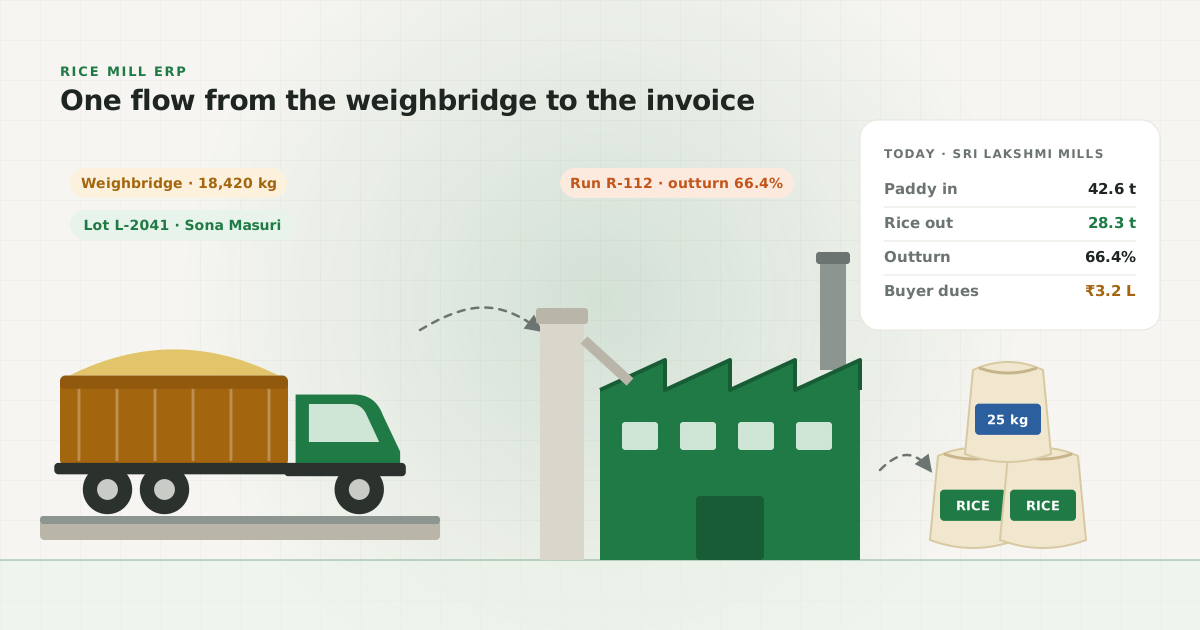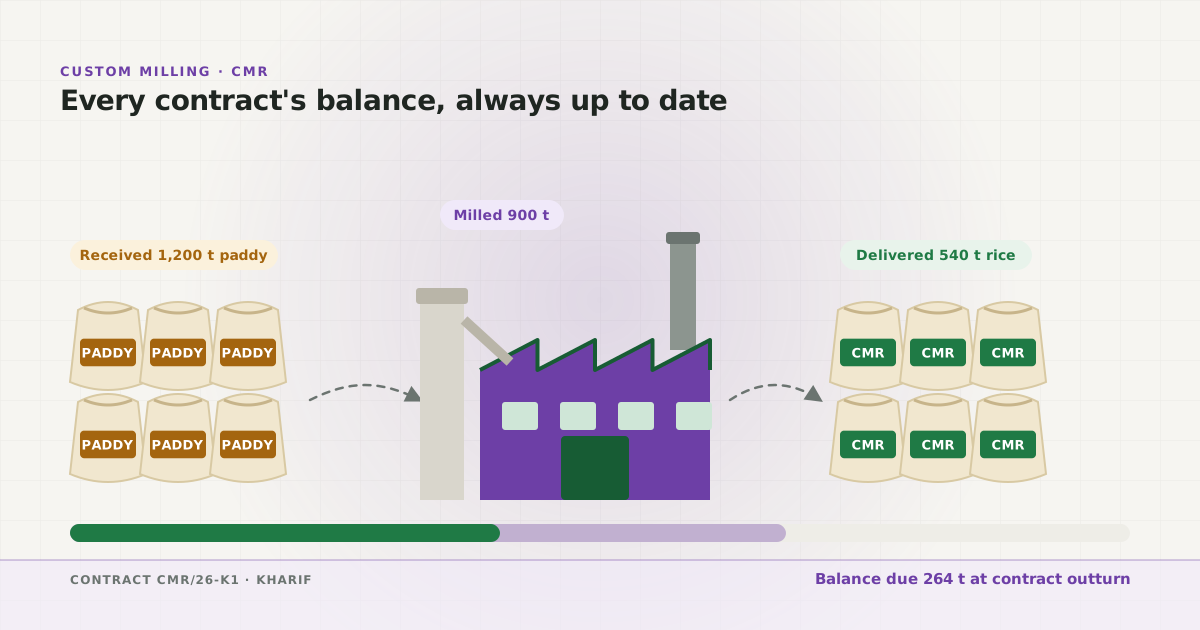
The gate is where a rice mill makes or loses money
During harvest a mill may take in dozens of lorries a day. Each one has a gross and tare weight, a moisture reading, a grade, a rate, sometimes a broker, and a farmer who wants to know what he will be paid. If any of those is wrong, the mistake follows the paddy all the way to the outturn report – or turns into a dispute that costs a supplier.
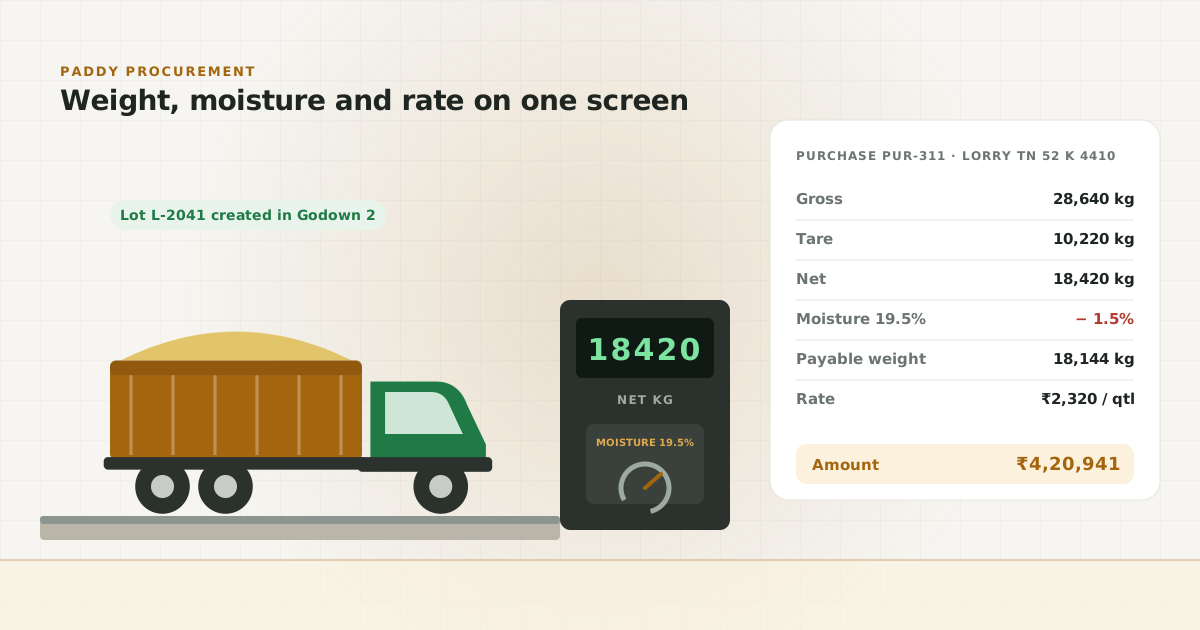
Grano puts the whole gate on one screen. The operator chooses the supplier and variety; the weights come from the weighbridge connector or are typed from the slip; moisture and grade are entered once. The system applies your moisture deduction rule and grade rate, works out net weight and amount, and saves the purchase together with a new paddy lot in the godown you choose.
Weigh now, price later
Many mills do not want gate staff deciding prices. In Grano, operators and staff never see or type a rate. Their loads save with weights, quality, lot and stock, marked as price pending. The owner or manager prices them later on the Price pending screen, which posts exactly the same ledger rows a priced purchase would. The farmer's WhatsApp says the rate is to follow, and a second message carries the rate once it is set. An alert stays open while any lorry is waiting.
What each paddy purchase writes
- A purchase entry with gross, tare, net, moisture, grade and rate.
- A paddy lot in a godown and stack, so the load can be traced through milling.
- A stock movement adding paddy to that godown.
- The supplier payable, plus broker commission to the broker's account where there is one.
- An automatic adjustment against any advance already paid to that supplier.
Because each load is its own lot, you can later see the outturn of a particular supplier's paddy, or compare varieties across the season. As an illustration: if two suppliers deliver the same variety but one consistently gives a lower outturn, that difference is visible in the lot reports – useful when you next agree a rate.
Mistakes still happen at a busy gate. A wrong entry is never deleted: it is voided with a reason, the name of the person who voided it and the time, and the stock and ledger rows are reversed with it. The evening check is then simple – the count of weighbridge slips should match the count of purchases, and any voided load has a written explanation.
Payments are entered against the supplier from a phone, by cash or bank, and the statement shows opening balance, purchases, advances, payments and closing balance for any date range. Vendor dues appear as an alert on the dashboard so nothing is forgotten. Purchases, lots and stock are in every plan, from ₹4,999/month; the weighbridge connector is an add-on, and screens work in Tamil, Hindi and English.
How is moisture deduction calculated on paddy?
Each mill sets its own rule for the season, usually agreed with brokers and farmers. A common form is a weight cut for every point of moisture above a limit. The deduction is applied to the net weight, and the rate is then applied to what is left.
A worked example, with an illustrative rule of a 1% weight cut per point above 17% moisture. The lorry weighs 18,450 kg gross and 6,250 kg tare, so net weight is 12,200 kg. The moisture meter reads 19%, two points above the limit, so the cut is 2% – 244 kg. Payable weight is 11,956 kg, or 119.56 quintals. At ₹2,300 per quintal, the load is worth ₹2,74,988. If the broker's commission is ₹10 a quintal, ₹1,196 goes to the broker's account. If the farmer took a ₹50,000 advance before harvest, it is adjusted on this purchase and the balance payable is ₹2,24,988.
In Grano the operator only types the weights (or takes them from the connector), the moisture reading and the grade. The rule, the rate and the advance adjustment are applied the same way on every load, and the farmer's WhatsApp receipt shows each line, so the argument at the gate is about the reading, not the arithmetic.
A harvest day at the gate
On a busy day 40 lorries may come in between morning and night. The first operator takes the morning shift and the second takes over after lunch, both on phones. Each lorry is weighed, sampled and saved in two or three minutes, and the lot goes into the godown and stack the godown keeper calls out. Loads from new farmers are saved with price pending if the owner has not agreed a rate.
At night the owner opens Price pending, sets the rates for the day's unpriced loads and checks the supplier balances. The next morning the accountant pays the farmers who are due, by cash or bank, and each payment settles against the supplier's statement.
Before the season starts: a checklist
- Write down your moisture deduction rule and enter it per variety – then every operator applies the same cut.
- Set grade rates so a better grade moves the rate the same way for everyone.
- Add brokers as their own accounts, so commission is not mixed with the farmer's payable.
- Enter advances already paid, so they are adjusted on the first purchase and not forgotten.
- Name godowns and stacks before the first lorry, so every lot has a place.
- Check that suppliers' WhatsApp numbers are correct – a wrong number means a missing receipt and a phone call.
- Decide who can set rates. Operators and staff save loads with the price pending; the owner or manager prices them.
The most common mistake is changing the deduction rule in the middle of the season without telling the gate. If the rule changes, change it in Grano on a fixed date, so every load after that date uses the new rule and every load before it keeps the old one.